
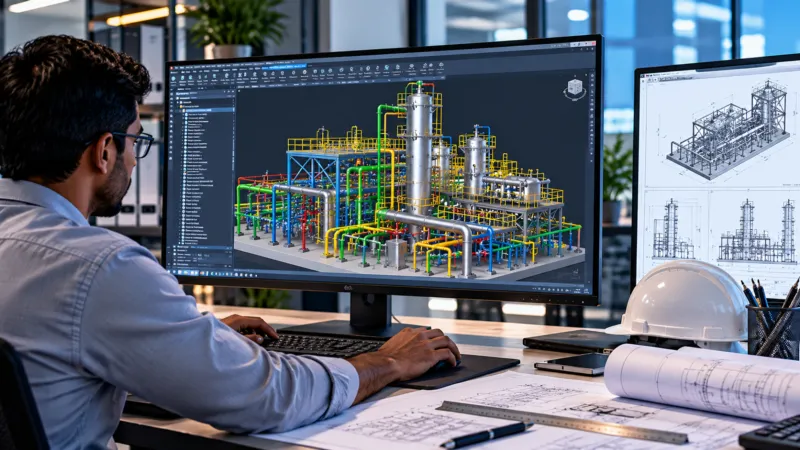
Not every pipe needs a computer stress model, but getting the selection wrong can lead to leaking flanges, overloaded equipment nozzles or failed supports. Most projects use a line criticality list to decide.
Key takeaways
- Temperature, size and connected equipment drive stress criticality.
- Rotating equipment nozzles have tight allowable loads.
- Formal analysis is usually done in CAESAR II to ASME B31.3 or B31.1.
Typical triggers for formal analysis
- High or very low design temperatures
- Large-bore lines connected to pumps, compressors or turbines
- Lines connected to air coolers and sensitive exchangers
- Relief and flare lines with dynamic loads
- Lines subject to slug flow, water hammer or vibration
- Jacketed, lined or non-metallic piping
What the analysis checks
The engineer checks sustained, expansion and occasional stresses against code allowables, confirms nozzle loads are within equipment limits (for example API 610 for pumps), and designs supports, guides and anchors to control movement.
Start early
Stress input during layout is far cheaper than rerouting after the model is complete. Involving stress engineers at the 30% model review keeps layouts flexible.